
Every month I pour R350 down the drain; and I’m sure you do to. That’s how much I spend on heating water for showers, washing dishes. Geysers and Hot water are a great place to focus any energy-saving measures as for most homes it’s the single biggest spender. This post helps you work out how much your spending; that’s always the first step to making intelligent energy savings.
It’s not just us at Homebug that say Geysers are the key to your energy savings, the City of Cape Town’s “Smart Living” handbook can’t get enough of them either.
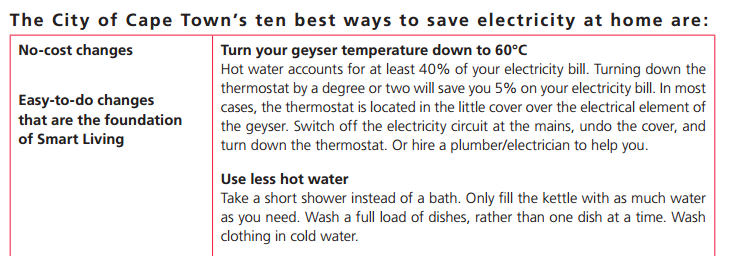
But how can you tell if it’s really your geyser that’s causing your big bill or not?
This little how-to is a bit longer than most, so please bear with us. At the very least at the end of this you’ll be able to tell all those solar-water-heater sales men that they haven’t got a clue; and at the most you’ll probably find a way to save loads of money!
We’ll split the calculation into 2 parts:
- How much electricity you need to heat the hot water you use
- How much electricity you need to keep your geyser hot
Right, let’s get started!
How much hot water do I actually use?
The first step is figuring out how much hot water you use. Most of your hot water is probably used when showering or bathing in the morning – so maybe have a look at our article on that here.
Using data from my Homebug, I can work out that I use around 100L of hot water per day (I’ll show you how I did that in a different article!), that’s from showering, bathing the kids, washing up etc. My hot water is set to 60 degrees, I can see that on my geyser. That’s all I need to know for this bit. Using a bit of science the amount of energy I use up in the hot water is:
- 100 Litres of water is the same as 100 kilograms of water
- Hot water is 60 degrees, and cold water is around 15 degrees – so I want to heat it up by 45 degrees (60 minus 15)
- The ‘specific heat capacity’ of water is 4.2 KJ/kg/Degree — don’t worry if you don’t understand what this is, but we need it to convert the degrees-C and kilograms of water into how much energy we need (it’s the same for all water everywhere, as long as it’s not turned into steam or ice!)
- The calculations goes: 100 x 45 x 4.2 = 18,900 Kilo Joules of energy
- We normally see energy in our electricity meter and bill as kilo-watt hours, rather than kilo-joules, so we have to divide by 3,600 (the number of seconds in an hour) to convert them — so 18,900 KiloJoules is 5.25 kilowatt-hours (18900 ÷ 3600 = 5.25)
So basically I use 5.25 electricity credits every day heating up water. But your geyser uses more energy than that, it has to keep the water hot for when you need it. That’s what we work out next!
How much energy does my geyser use without me!
Geysers, just like kettles, lose heat through their walls. When they are turned off the water inside will slowly cool down to the same temperature as outside the geyser. When a geyser is turned on it automatically switches itself on and off to keep that temperature the same – like a kettle being switched back on once the water gets too cold. Fortunately your geyser has a lot of insulation so that is doesn’t lose heat too quickly and even more luckily for us working out this calculation, modern geyser’s are even required to test how much they lose.
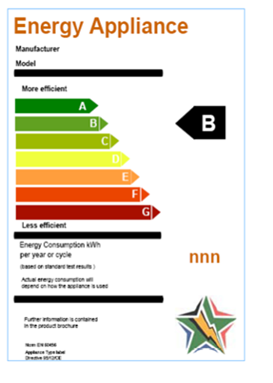 If you have one of these modern geysers it may have an energy category on the side with a letter from A to G like the picture on the right. If you’re geyser is rated A it is very efficient and very green, all the way down to G which is very inefficient. These categories depend on a test and little formula from SABS/SARS.
Standing Losses = F + xV0.4
Don’t we’re not going to dive into that… instead I’ve put the results of that calculation in a table below.
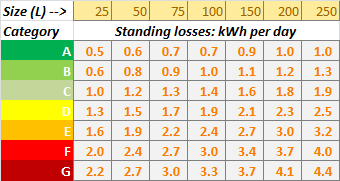
I have a 200L tank that is category E – so my geyser uses 3.0kWh per day, just keeping itself warm – regardless of whether I use ANY hot water. If you don’t have an energy rating on your geyser, it’s probably pretty low down. Very old ones and ones stored outside will be much worse even than these figures – but to be on the safe side, just assume they are category G — e.g. so if I have an old 200L geyser, it probably uses a little more 4.1kwh/per day staying hot. Luckily I’ve got a more efficient one than that and only use 3.0 units/day!
Combining the numbers
To work out how much your geyser uses you need to just add the two numbers that we’ve worked out:
5.2 kwh/day for actual hot water (down the drain!) + 3.0 kwh/day for keeping it hot (in my airing cupboard!) = 8.2kwh/day
So looking at a month, we need to multiple by the number of days – 8.2 x 30 days = 246 kwh/month
And finally to convert that to Rand, we need to multiply by the cost per unit of electricity. I worked out that last month I paid R700 for 491 units — so that’s R1.425 per unit (if that sounds like a lot to you, then you must not live in Cape Town – we have the most expensive electricity! See how your’s compares here)
So finally I take 246kwh/month and multiply by 1.425 to get R350.55. I spend R350.55 each month on hot water – then I throw it down the drain! How about you?
Please comment if you’ve got stuck or if you’ve got any questions. We’d love to hear from you.


Leave a Reply to With the new power price, solar geysers are almost – but not quite – starting to make financial sense – The Village News Cancel reply